
Volume 6, Issue 27: Boyhood
"We're all just winging it, you know? The good news is you're feeling stuff. And you've got to hold on to that."
Here is a button where you can subscribe to this newsletter now, if you have not previously done so. I do hope that you enjoy it.
Roger Ebert has been—remains, really—my role model and writing hero since I was a preteen, someone who thought of the act of living as almost an art: He was, to the very end, engaged and active in this world, constantly trying to make sense of it, always writing his way through, distilling, even purifying, his thoughts through constant reflection and incessant, relentless work. (I would end up of course having a personal history with Roger as well.) He was one of those writers who I respected so much that when he wrote something I disagreed with, it made me reassess my own beliefs, triple-check myself to make sure I’d thought it through entirely. Every single word I write has a little bit of Ebert in it.
But I will never forget the time when he struck me as helplessly old and out of touch.
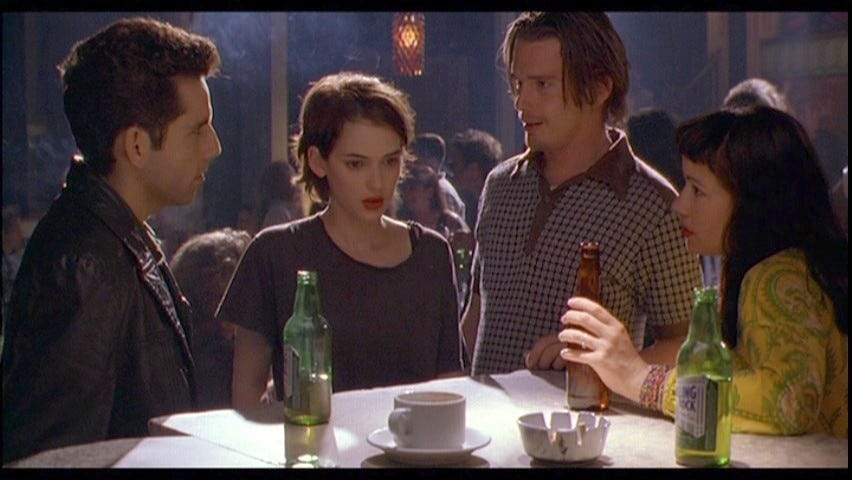
It was his review of Reality Bites, the 1994 Ben Stiller-directed movie starring Ethan Hawke and Winona Ryder (and Steve Zahn and Janeane Garofalo) as Gen-X slacker kids trying to find their way through their listless but still hopeful twenties. I was 18 years old when Reality Bites came out, a freshman at the University of Illinois, and I thought the movie captured real, deep truths about what it felt like to be young at that specific moment in history, to want to be a part of something beautiful, profound and important but not really knowing how to, while finding yourself pinned in from every direction. Hawke’s Troy character is the smart jackass antihero, but, even then, I identified more with Ryder’s Lelania, an idealist budding filmmaker who has so much she wants to say but isn’t sure how to say it, so she just films everything she sees, trying to find something real, something lasting. She ends up meeting a slick producer at an MTV-like network named Michael (played by Stiller), and then the movie has its love, and moral, triangle.
In the key moment in the movie, we finally get to see all the footage that Lelania has been shooting, but now packaged by Michael in the hackneyed, hyper-produced, narratively simplistic way that reality television was always packaged by MTV in the ‘90s, taking something meant to exhibit “reality” and turning it into something bland, empty and commodified. When Lelania sees the footage, she’s so appalled she breaks up with Michael and runs back to Troy (and her other, more “real” friends) and commits to continuing to follow that truth and capturing the world as it actually is rather than as it is sold, a sentiment that’s even more Gen-X than the floppy hair, wispy goatees, flannel and Evan Dando that otherwise populates the movie. The movie hit me hard. These were people I knew. It made me want to go out and document the world I saw—to create, to live, man.
I was 18.
Ebert’s review did not see the movie the way I did.
The documentary-in-progress is supposed to record the passage of Generation X from college into an unfriendly job market, but actually what it records is callow and superficial behavior by kids who do not inspire us to wish we knew them better. … We are expected to accept Lelaina, I guess, as a committed cinema verite documentarian in the tradition of Frederick Wiseman; Michael (Stiller) as a crass corporate monster; and Troy as a rebel who sees through phoniness. This is all wrong. On the basis of the footage we are allowed to see, Lelaina is not a filmmaker but simply someone who plays with a video camera. Nor are the friends she photographs especially interesting. What Michael’s people in New York do to the footage is an improvement. And Troy is a self-centered prig who is not half as clever as he thinks he is.
But of course these observations go against the deep-seated prejudices of the movie, which are that anyone who shoots documentary video footage of friends is a genius; anyone who is pushing 30 and has a good job has sold out; and anyone who is simultaneously unemployed and hostile is a reservoir of truth.
I was stunned—jaw-dropped, really. This was not a case of Ebert seeing a movie differently than I did: That happened all the time. This was Ebert fundamentally misunderstanding a whole generation, of not being able to see what we were all about, what we were all trying to do, what “reality” was—what we saw, and what we didn’t want to see. Ebert didn’t just seem wrong to me: He seemed impossibly, almost embarrassingly, old. He seemed like his time has passed. It was a formative moment for me that in retrospect was inevitable: The moment when I realized my heroes could be wrong, that there were some things I understood better than they could. It made me think that I had something to say. It made me feel like, someday, maybe someday soon, a torch could be passed.
When Roger Ebert wrote that review for Reality Bites, he was 51 years old, one year older than I am right now.
The two biggest movies in the country right now are Backrooms and Obsession. They are both stylishly directed horror movies, but they are not thematically connected or even dramatically similar. But they have one crucial thing in common: They are directed by children.
Well, not children exactly, but close. Obsession is directed (and written) by Curry Barker, a 26-year-old sketch comedian who expanded a short called “The Chair” he made for his YouTube channel in 2023 into Obsession. Backrooms is directed (but not written) by 20-year-old Kane Parsons, whose own YouTube channel featured a series of short videos in which abandoned malls and warehouses were shot in a way to make them seem mysterious and scary, these “liminal spaces” feeling both infinite and oppressive. These shorts—along with other online “creepypasta” that people added to themselves—led to an online series called “Backrooms,” which developed a vast mythology and eventually took on a life of its own.
I did the best job writing that paragraph from a perspective of expertise that I could, but honestly, I really don’t understand it, was never a part of any of that and only learned about all of it after seeing each of the movies. I don’t watch YouTube videos, I don’t scroll vertical video, I don’t spend time in online chatrooms, backrooms or otherwise. I’m just guessing from information other people have provided me. I know nothing about this at all. I only know the movies.
But these movies are huge. They are in fact transforming the entire industry, and perhaps pointing to a new direction for movies entirely, the next generation taking over an art form and making it their own. There are young kids seeing these Obsession and Backrooms and falling in love with movies forever, the same way I did when I saw Hoop Dreams and Short Cuts and Do the Right Thing and fell in love with them myself. This is an unalloyed good. This is what any movielover wants.
This does not change the fact that, well, I don’t think either of these movies are very good.
As you know as a loyal, dedicated listener of the Grierson & Leitch podcast, I see nearly every movie that comes out. Movies are central to my life and how I see the world, and I see ‘em all, from the transcendent to the idiotic. (I will be seeing Scary Movie not long after I finish this newsletter. I’m a completist!) I love going to the movie theater, and, all told, it doesn’t really matter to me what other people like or what makes other people come out to the theater. The experience of movies is personal to me—in the same way, I’d argue, it was for Ebert. People responded to him not because they agreed or disagreed with him, but because he came from a place of fundamental truth and honesty. He was, to use the currently in vogue term, authentic.
So my authentic take is not just that these movies are not good, but that the reason that they are not good is because, well, they are made by children.
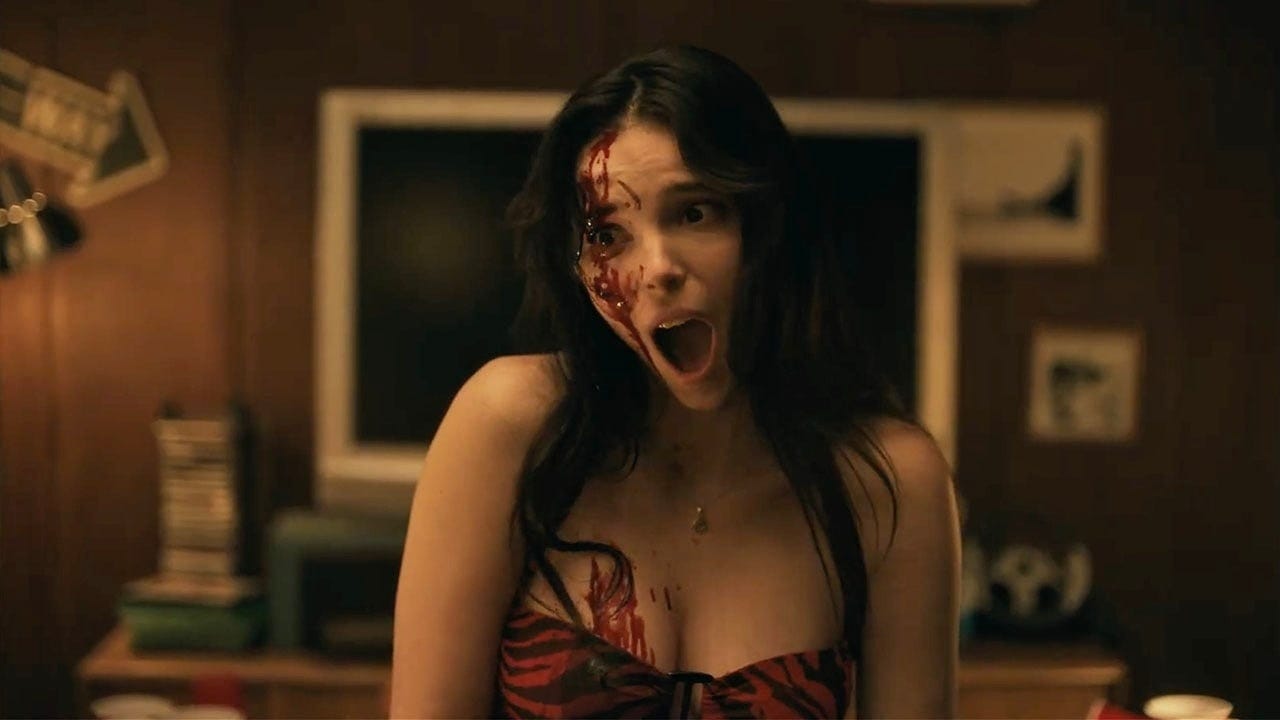
Of the two movies, I think Obsession is the better one, mainly because it has a terrific central performance from an actress I’d never seen before named Inde Navarrette. She plays a woman in her early 20s named Nikki who works at a record store (owned by Andy Richter!) with a group of similarly aimless twentysomethings. Nikki is smart and independent and intelligent, but we only get to see all of that for a short time. You see, one of the guys she works with is a squishy little shit named Bear (played with ineffectual loathsomeness that may or may not be intentional by Michael Johnston) who has a crush on her but is afraid to tell her so. He ends up stumbling across a novelty toy called a One Wish Willow, which, like a genie, allows the user one wish to come true. Because he is an impulsive loser, he wishes for Nikki to “love him more than anyone in the world.” Within seconds, she is, well, obsessed with him, seemingly possessed by a demon that forces her to destroy anything that might stand between her and Bear. It is fair to say that complications ensue. The movie is at its best when it just lets Navarrette cook. Barker’s best conceit is that Nikki, the real Nikki, is in fact still inside there somewhere, fighting to get away from this curse Bear has put upon her, and Navarrette is incredible at showing us the brief moments when Nikki emerges and screams for escape. Unfortunately, the movie itself becomes increasingly nonsensical and scattershot—the movie, like its director, desperately needs a grownup to show up and clean up the messes these kids are making—and the movie’s jump scares are artificial and arbitrary. (Half the “scary” things Nikki does in this make absolutely no sense other than just to allow Barker to show something gross and weird on screen.) And I’m far from convinced that Barker has the disgust with Bear—who basically steals a woman’s soul and autonomy out of his own loneliness and insecurity—that Barker’s defenders try to give him credit for: I think he identifies with this schmuck and is legitimately on his side. The movie is not terrible—again, Navarrette is great, and the movie has some clever touches—but the movie is, more than anything, kinda immature. It looks like it was made by a kid.
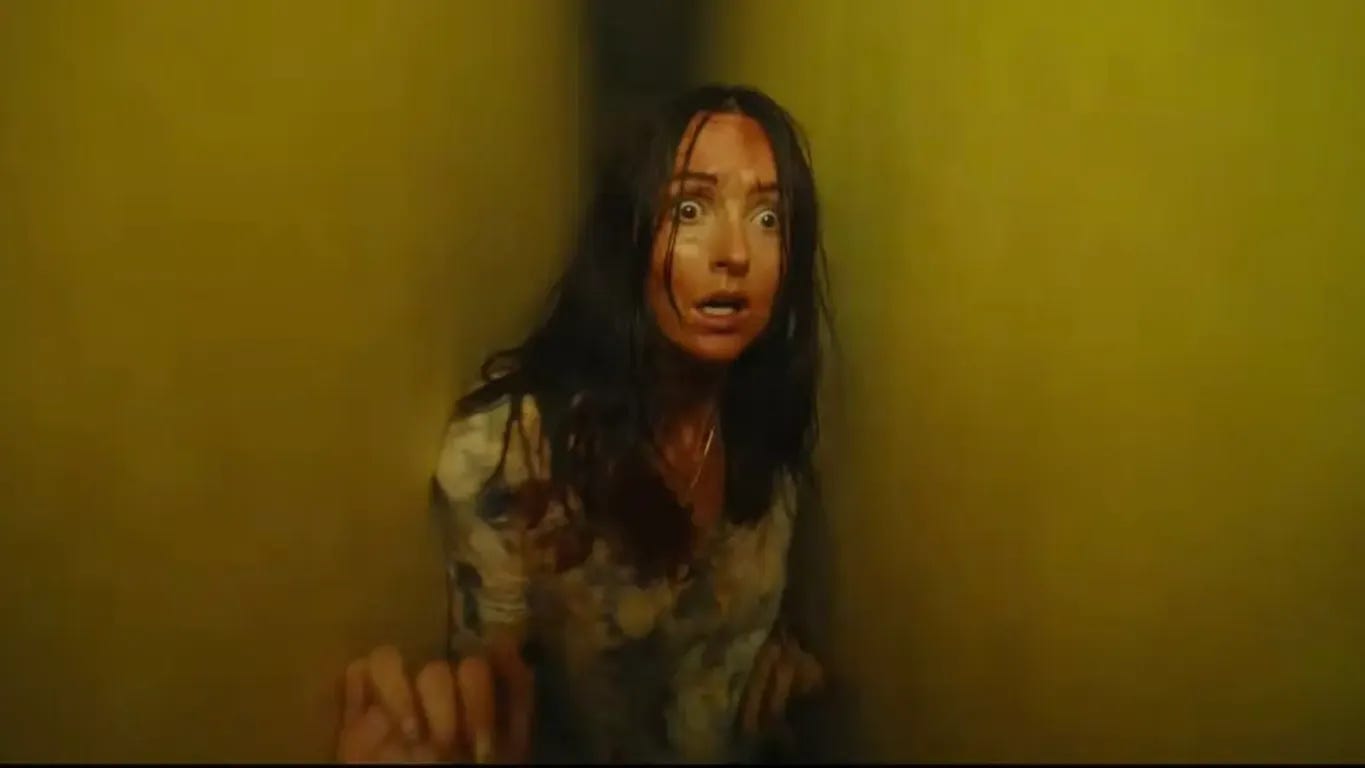
Backrooms feels even more so. It follows Clark (Chiwetel Ejiofor), an angry early ‘90s divorcee who works in a depressing furniture store who discovers that this store has a secret passageway that takes you … well, to infinity. The rooms go on forever, there are creepy sounds in the distance, normal life is slightly distorted. He makes two employees go down there with him, and eventually his therapist Mary (Renate Reinsve) goes there too. I would say madness ensues, but even madness has more narrative coherence than Backrooms. The movie wants to be creepy but not explain anything, which would be fine except it’s only a little creepy (but mostly just odd) and then it tosses in a character in a lab coat at the end of the film who ostensibly tries to explain everything but seems to exist only to try to set up a sequel. The characters are laughably thin, like Parsons read an Wikipedia entry about Problems Adults Have. Richard Lawson at his newsletter Premiere Party got this exactly right:
Clark’s problems are generic to the point of absurdity; Parsons seems to understand that sometimes money and work are stressful for grownups, and so he has this grownup say that money and work are stressful. Parsons might as well walk into frame and recite, “Webster’s Dictionary defines adulthood as…” Mary gets a little more nuance, but her motivations and backstory are kept at such a remove that they barely register. It’s all so wan and simple and un-engaging, these sketches of problems that Parsons has only heard about.
Backrooms, as Vulture’s Alison Willmore put it, is all vibes: It falls apart entirely if you think about any of it for even a second. But Kane Parsons was a teenager when he made Backrooms. I’m sure he didn’t consider any of that. He’s just making a creepy movie based off his creepy YouTube videos. That’s all he wanted to think about. Considering how financially successful the film has been, that’s apparently all he needed to think about. It has worked. And it has worked specifically with young people like him, who find the movie (and Obsession) brilliant, even paradigm-shifting.
I see those movies and see interesting and well-crafted but flawed, kinda-dumb movies made by young people who will someday be better at making movies than they are now because they will get older and learn a little bit more about what the world is all about.
But young people see those movies and they see the future.
And they would read this and look at me the same way I looked at Ebert: As an old man who doesn’t get it. Who can’t see which way the wind is blowing.
I think they’re completely wrong. But I would, wouldn’t I?
Part of getting older is realizing that you understand the world better than you used to at the exact moment that your world starts getting smaller. I do not keep up with YouTube sensations, or influencers, or celebrity scandals, not because they are not important, but because they are not important to me. I do not have time for them. I have a family. I have a job. (I have several jobs.) I have, as I’ve gotten older, learned what I care about and learned what I do not, and I have focused all my attention on the former and none of it on the latter. This makes me smarter about some things, and better at the things that I’m already skilled at, but completely clueless about others.
It makes me right. But it also makes me completely wrong.
Young people see something in Obsession and Backrooms that I, apparently, cannot see. But I would say the same thing to them: That their belief that they are a part of something, that this is the future, is blinding them to something that is plainly lacking in the present. I see what they can’t. They see what I can’t. We are talking past each other. Just like Ebert and I were about Reality Bites 32 years ago.
The thing is, though: I watched Reality Bites again this week. And, specifically, I watched the scene that Ebert was writing about, the one in which Michael re-edits her footage. As Ebert ended his review: “her video was crap and [Michael’s] people in New York turned it into A-plus shinola.”
And, deep sigh, Ebert is right. Lelania’s aimless movie would have been terrible and self-indulgent, and Michael edited it enough to at least make it watchable. Ebert turns out to have been correct, way back then. I couldn’t see it at 18. But I could see it when I reached Ebert’s age. It strikes me as blindingly obvious.
Does that make me right then? Does it make me right now? I wonder if we’re both wrong. I wonder if we all are.
Which is of course the point of living, of all of this: To make mistakes, to be certain you are right and later discover you were wrong, to try to improve and get better … and still know you will never understand again what it is like to be young, and that the older you get, the less you will still know.
Ebert also once wrote that “movies do not change, but their viewers do.” They are fixed objects. Thankfully, the rest of us are not. We get to keep moving, keep changing, keep living, keep being right, keep being wrong, keep trying to figure all of this out, keep failing, and yet, still, keep trying.
Here is a numerical breakdown of all the things I wrote this week, in order of what I believe to be their quality.
A Guide For Bandwagon Knicks Fans, New York. Uh, holy crap, you guys?
Also, I did a Knicks video for the Post.The World Cup Will Probably End Up Fine, The Washington Post. I cannot wait for this to start.
Here’s your reminder to sign up for that free weekly newsletter with each of those columns, every Thursday morning, by the way. Right here. Free!The Cardinals Are Remaining Nimble and Smart, MLB.com. I had a very good sports night last night.
Seven Storylines To Watch in June, MLB.com. June’s already a fifth over!
The Toughest Calls on the All-Star Ballot, MLB.com. Vote Jordan Walker!
This Week’s Power Rankings, MLB.com. The Cubs were No. 1 in this, like, not long ago.
PODCASTS
Grierson & Leitch, We discussed “Backrooms,” “The Breadwinner” and “Exotica.”
Morning Lineup, I did Friday’s show.
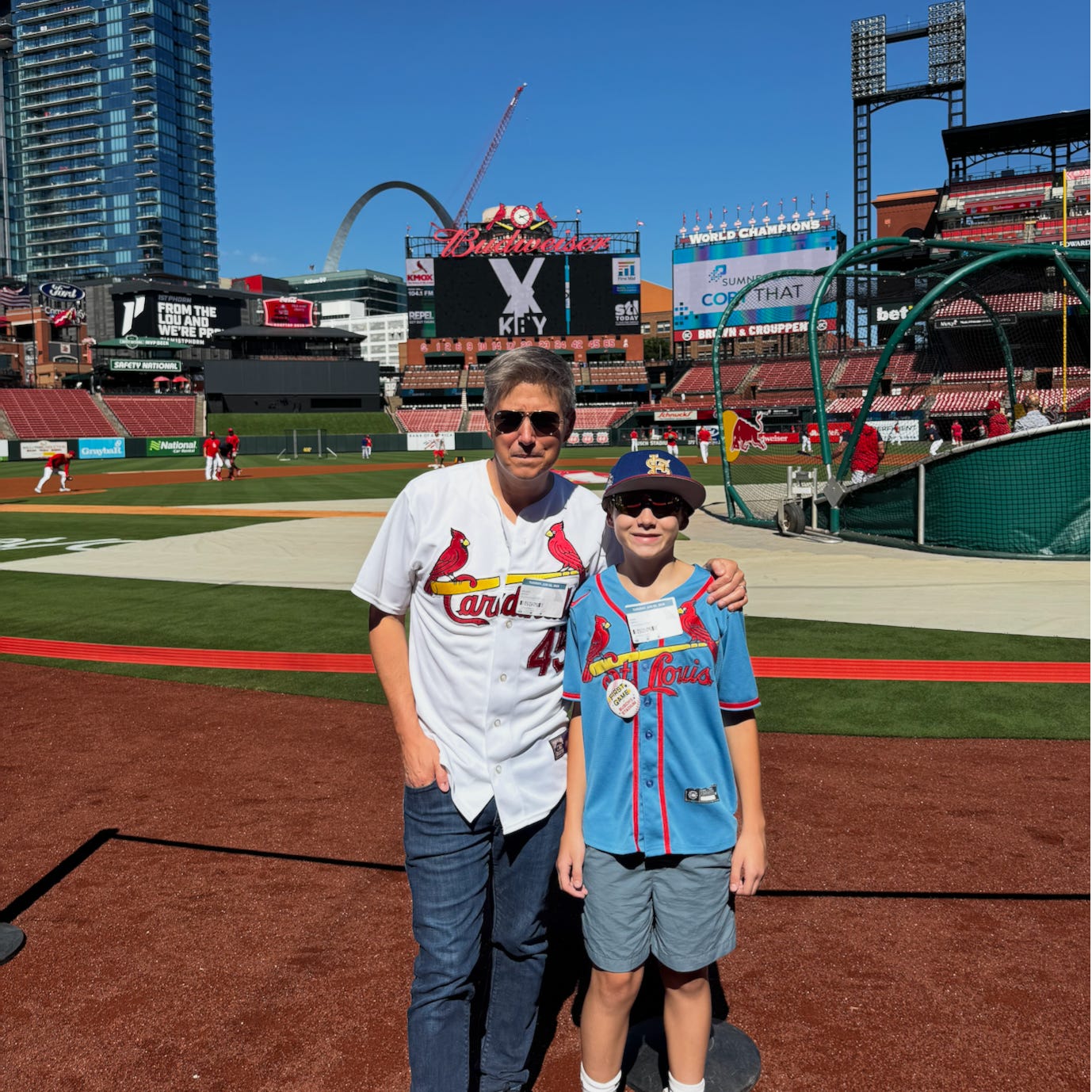
Seeing Red, Bernie and I talked before my first trip to Busch this year.
LONG STORY YOU SHOULD READ THIS MORNING … OF THE WEEK

“The Language of Soccer,” The Athletic. I loved this big feature about the soccer cultures (and songs) of each of the 48 qualifying countries.
ONGOING LETTER-WRITING PROJECT!
This is your reminder that if you write me a letter and put it in the mail, I will respond to it with a letter of my own, and send that letter right to you! It really happens! Hundreds of satisfied customers! I am behind on these again but catching up this week
Write me at:
Will Leitch
P.O. Box 48
Athens GA 30603
CURRENTLY LISTENING TO
“Stampede,” Genesis Owusu. The first time I heard this song, I thought “that looks like the soundtrack to people riding motorcycles,” and then I watched the video and, well, yep.
Remember to listen to The Official Will Leitch Newsletter Spotify Playlist, featuring every song ever mentioned in this section. Let this drive your listening, not the algorithm!
GOOOO KNICKS HOLY CRAP.
Have a great weekend.
Best,
Will
Thank you, this is the piece I wish I wrote about all of this! (My highest compliment, I think you understand.) I literally cited Reality Bites the other day while saying "this is good for movies" about these two new things directed by children. I viscerally remember walking home from the movie theater on the campus of Northwestern when I saw Reality Bites and it peered into my soul and Winona and Ethan became guiding figures in my life. I hope that's how the kids feel now!
I am just a couple years older than you and I haven't seen Reality Bytes since I saw it in the theaters. I liked it, and thought it definitely had the correct "vibes" (as the kids say today) for our generation, but I guess it wasn't shown enough on TBS or AMC later for me to give it a re-watch. I did listen to the soundtrack a lot.
All that said, I *do* remember one visceral reaction I had to the movie at the time: that Ben Stiller's character was right. I remember being confused over how he get rejected and was clearly positioned as the bad guy, when I thought...well, Roger Ebert wrote why. I won't try to re-write what he said better.
I don't know what that says about me. Perhaps, in spite of my love for all things grunge and (still ongoing!) suspicion about selling out, I really was not in touch with a true artist spirit. Which might be it -- I went in the corporate world once I graduated from college; I didn't become a writer.
In any case, I definitely do feel your pain about Obsession and Backrooms. I don't get it, but I realized once I had kids, many things are not for me to get. I try and if it doesn't take, on to the next one. Heck, I'm scrambling to see if I need to care about "The Amazing Digital Circus" which I hadn't heard of until two days ago and looks beyond basic to me, but apparently is based (in part) on "If I had a Mouth I Would Scream" (one of my teen daughters' favorites), so I have no idea if I will have to watch that, and likely be baffled, or not.
Enjoy your work.